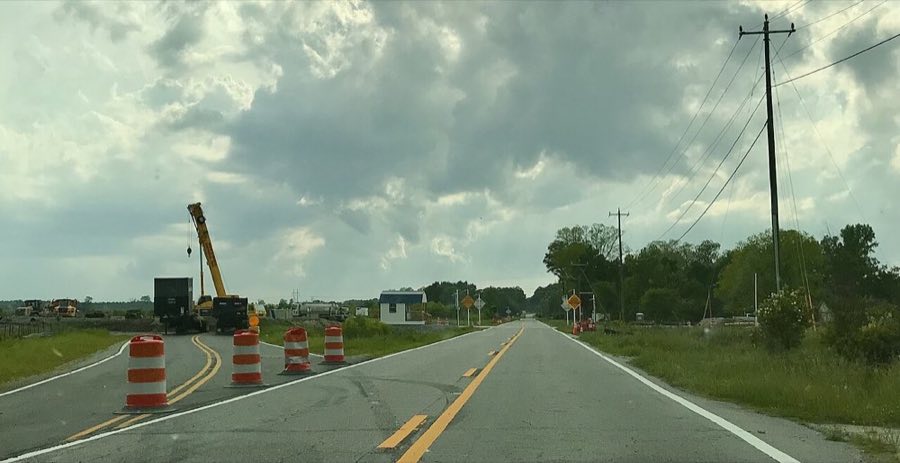

Locality · Museum spoil piles: free collecting
Aurora Fossil Museum spoil piles
Beaufort, North Carolina, United States
The Aurora Fossil Museum in Aurora, North Carolina, maintains free public spoil piles of Lee Creek mine sediment where families sift for Miocene–Pliocene shark teeth, ray plates and shells, the only legal way to collect Lee Creek material since the mine closed to visitors in 2009. The museum itself shows the megalodon jaws and whale skulls that made Lee Creek famous. Small teeth are guaranteed; a big megalodon from the piles is luck.
| Country | United States |
|---|---|
| State / province | North Carolina |
| County | Beaufort |
| Land manager / status | Aurora Fossil Museum (spoil donated by Nutrien); the mine itself is closed to the public |
| Access | Free, dawn to dusk, across from the museum; the annual Fossil Festival in May |
| Formations | Yorktown and Pungo River formations (Lee Creek) |
| What is found | shark teeth, Hemipristis, Carcharodon hastalis, Otodus megalodon, ray plates, Chesapecten, whale bone |
| Coordinates (public site) | 35.3, -76.79 |
Rules
The museum's outdoor piles of Pungo River and Yorktown spoil are free to dig with hand tools and everything found is yours. The Nutrien (formerly PCS) mine is closed to collectors except for occasional organised events; do not enter mine property.
Source: https://aurorafossilmuseum.org/ (checked 2026-09-16).
Collecting rules
Elsewhere
Cite this article
Stratum Study. "Aurora Fossil Museum spoil piles" (Locality). Stratum Study pack 2026.09, as of 2026-09-19. https://stratum.black/study/localities/aurora-fossil-museum-spoil-piles. Accessed 2026-09-20.
@misc{stratum-aurora-fossil-museum-spoil-piles,
  title        = {Aurora Fossil Museum spoil piles},
  author       = {{Stratum Study}},
  howpublished = {\url{https://stratum.black/study/localities/aurora-fossil-museum-spoil-piles}},
  year         = {2026},
  note         = {Locality article, Stratum Study pack 2026.09, as of 2026-09-19; sources: stratum, commons. Accessed 2026-09-20.}
}
Citations carry the pack version and the article's as-of date so they resolve to the same text later. The facts themselves belong to the sources listed below; cite those for the science.