
Variety · Quartz group
Agate
SiO2
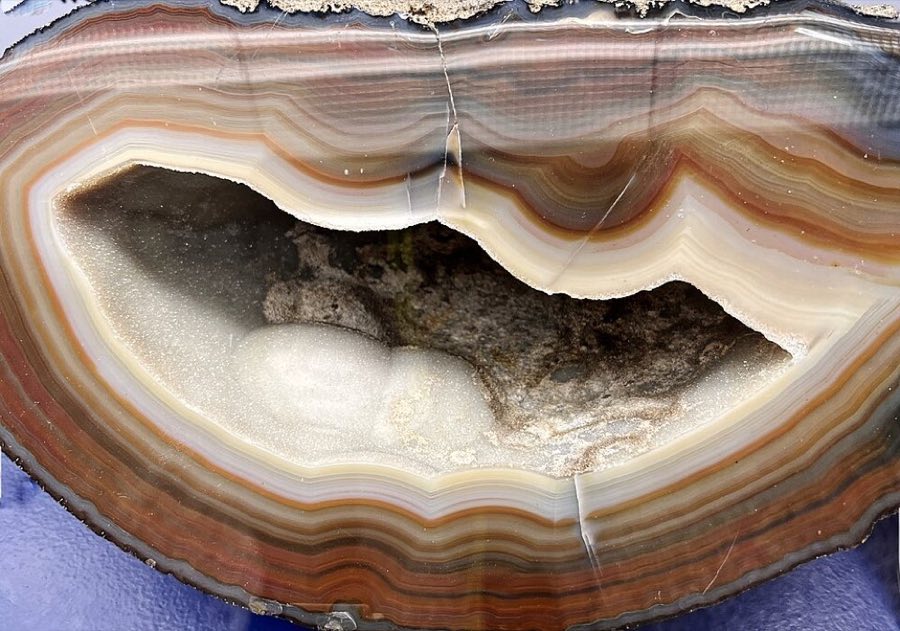
Agate is banded chalcedony formed in gas cavities of volcanic rocks; Brazilian and Uruguayan nodules from the same basalts as amethyst, Lake Superior agates, Botswana, Condor and Laguna agates are the collector classics. Slices and polished nodules are cheap; rare patterns and fire agate cost more. Agate is the most treated mineral in the trade.
| Formula | SiO2 |
|---|---|
| IMA status | variety |
| Crystal system | Trigonal |
| Mohs hardness | 6.5–7 |
| Group | Quartz group |
| Type locality | Achates River, Sicily (historical) |
Fakes and treatments
Brazilian agate slices in bright blue, pink, purple and green are dyed; natural agate is grey, white, brown and red. Heat-treatment reddens iron-bearing agate. Sold honestly, dyed agate is fine; sold as natural, it is fraud.
Elsewhere
- Wikidata: Q123314
- Wikipedia: agate
- Mindat: Agate
Cite this article
Stratum Study. "Agate" (Mineral). Stratum Study pack 2026.09, as of 2026-09-19. https://stratum.black/study/minerals/agate. Accessed 2026-09-20.
@misc{stratum-agate,
  title        = {Agate},
  author       = {{Stratum Study}},
  howpublished = {\url{https://stratum.black/study/minerals/agate}},
  year         = {2026},
  note         = {Mineral article, Stratum Study pack 2026.09, as of 2026-09-19; sources: stratum, wikidata, commons. Accessed 2026-09-20.}
}
Citations carry the pack version and the article's as-of date so they resolve to the same text later. The facts themselves belong to the sources listed below; cite those for the science.