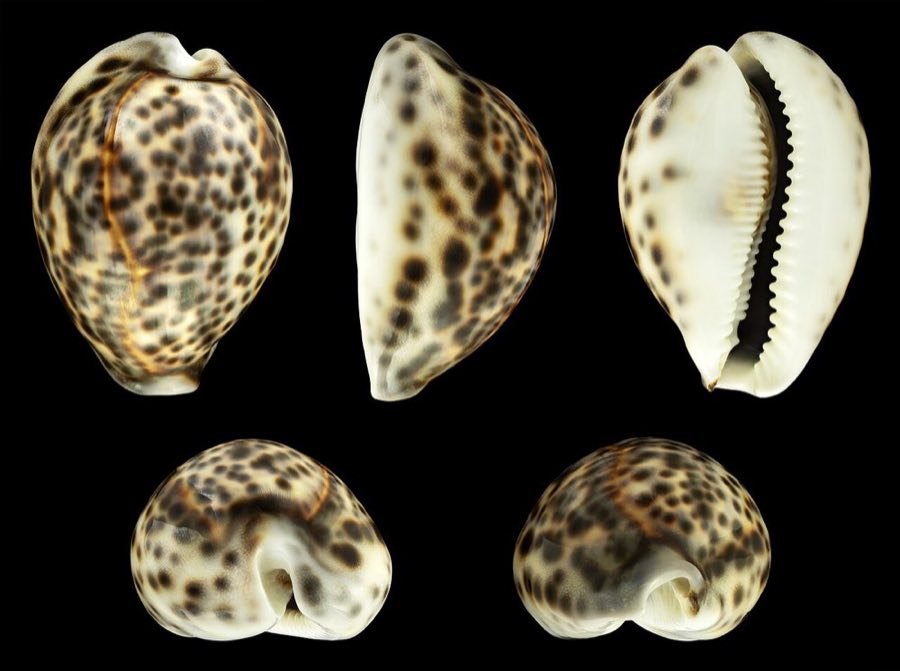

Shell · Family (cypraeidae)
Cypraea
Cowries
Cowries (family Cypraeidae, historically all in Cypraea) are the glossy, egg-shaped shells whose mantle covers the shell in life, giving the porcelain finish; the golden cowrie, Cypraea aurantium, and the rare Leucodon and Guttata cowries are among the most valuable shells collected. The genus Cypraea now holds only the tiger and Cypraea pantherina, with the rest in dozens of genera. Gem-quality cowries are judged on gloss, pattern and absence of growth lines.
| Habitat | Reefs and rocky shores, mostly tropical, under rocks and coral by day |
|---|---|
| Regions | Indo-Pacific, Caribbean, West Africa, South Africa, Mediterranean |
| Family | Cypraeidae |
| Authority (WoRMS) | Rafinesque, 1815· WoRMS / MolluscaBase |
| Status (WoRMS) | accepted· WoRMS / MolluscaBase |
| Extinct (WoRMS) | no· WoRMS / MolluscaBase |
| Classification (WoRMS) | Animalia › Mollusca › Gastropoda › Littorinimorpha › Cypraeidae· WoRMS / MolluscaBase |
CITES and protection
No cowrie is CITES-listed (September 2026); some, such as the South African Cypraeovula species, are protected nationally, and the tiger cowrie is commercially harvested. Money cowries were historic currency and are unrestricted.
Care (Byne's disease)
Glossy cowrie shells show Byne's efflorescence as a white bloom that dulls the gloss; keep them away from acidic wood and paper.
Elsewhere
- WoRMS AphiaID: 23022
- Wikidata: Q312056
- WoRMS / MolluscaBase record
- Wikipedia: Cypraea
- CITES Appendices
Cite this article
Stratum Study. "Cypraea" (Shell family). Stratum Study pack 2026.09, as of 2026-09-19. https://stratum.black/study/shells/cypraea. Accessed 2026-09-20.
@misc{stratum-cypraea,
  title        = {Cypraea},
  author       = {{Stratum Study}},
  howpublished = {\url{https://stratum.black/study/shells/cypraea}},
  year         = {2026},
  note         = {Shell family article, Stratum Study pack 2026.09, as of 2026-09-19; sources: stratum, worms, wikidata, commons. Accessed 2026-09-20.}
}
Citations carry the pack version and the article's as-of date so they resolve to the same text later. The facts themselves belong to the sources listed below; cite those for the science.