
Shell · Genus
Nautilus
Chambered nautilus
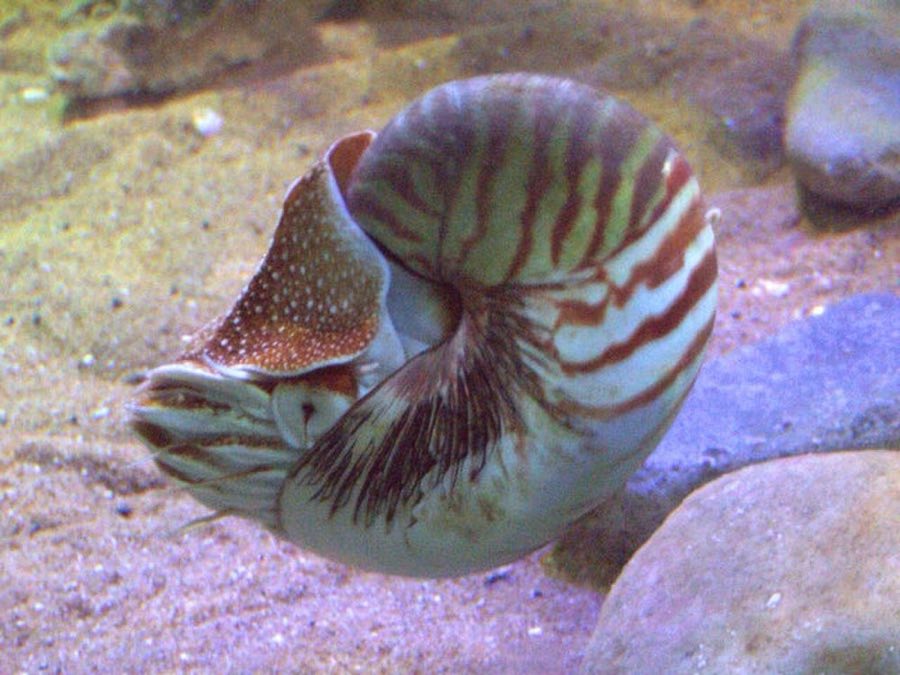
The chambered nautilus is the living relative of the ammonites, with a coiled shell divided by simple sutures, harvested in the Philippines and Indonesia for the shell trade until CITES listing in 2017. Whole shells, cut halves showing the chambers and pearly polished shells are common in older collections and must now carry permits to trade internationally. Stratum's compliance gate flags Nautilus; see the fossil taxon article for Eutrephoceras and other extinct nautiloids.
| Habitat | Deep reef slopes 100–500 m, Indo-Pacific |
|---|---|
| Regions | Philippines, Indonesia, Palau, Fiji, Australia, New Caledonia |
| Family | Nautilidae |
| Authority (WoRMS) | Linnaeus, 1758· WoRMS / MolluscaBase |
| Status (WoRMS) | accepted· WoRMS / MolluscaBase |
| Extinct (WoRMS) | no· WoRMS / MolluscaBase |
| Classification (WoRMS) | Animalia › Mollusca › Cephalopoda › Nautilida › Nautilidae· WoRMS / MolluscaBase |
CITES and protection
All Nautilidae (Nautilus and Allonautilus) are CITES Appendix II since 2 January 2017; cut and polished shells, pearl-nautilus jewellery and whole shells need export permits, and the USA also lists them under the ESA. Fossil nautiloids are not covered.
Care (Byne's disease)
Nautilus shells are thin and aragonitic; polished 'pearl' shells have had the outer layer ground away and are fragile.
Elsewhere
- WoRMS AphiaID: 204549
- Wikidata: Q1324463
- WoRMS / MolluscaBase record
- Wikipedia: Nautilus
- CITES Appendices
Cite this article
Stratum Study. "Nautilus" (Shell family). Stratum Study pack 2026.09, as of 2026-09-19. https://stratum.black/study/shells/nautilus. Accessed 2026-09-20.
@misc{stratum-nautilus,
  title        = {Nautilus},
  author       = {{Stratum Study}},
  howpublished = {\url{https://stratum.black/study/shells/nautilus}},
  year         = {2026},
  note         = {Shell family article, Stratum Study pack 2026.09, as of 2026-09-19; sources: stratum, worms, wikidata, commons. Accessed 2026-09-20.}
}
Citations carry the pack version and the article's as-of date so they resolve to the same text later. The facts themselves belong to the sources listed below; cite those for the science.