
Formation · Ordovician
Kope Formation (Cincinnatian)
Late Ordovician unit, Ohio · Kentucky · Indiana
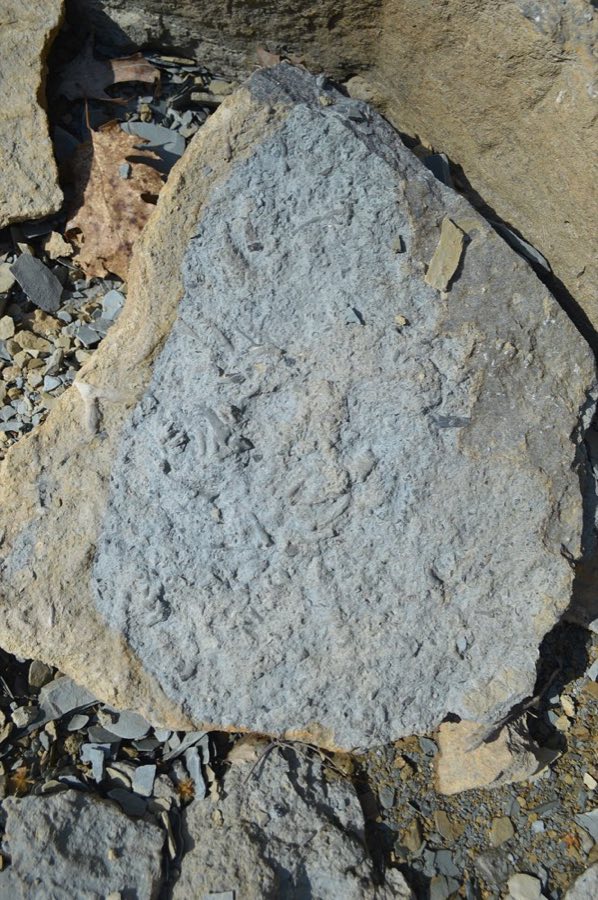
The Cincinnatian Series (Kope, Fairview, Bellevue, Waynesville, Liberty formations and others) of southwestern Ohio, northern Kentucky and southeastern Indiana is the most fossiliferous Ordovician sequence in the world: Flexicalymene trilobites (often enrolled), the giant Isotelus (Ohio's state fossil), the lace-collared Cryptolithus, Platystrophia and Rafinesquina brachiopods, bryozoans, crinoids and the coiled gastropod Cyclonema. Enrolled Flexicalymene in shale are cheap and genuine; complete Isotelus are museum pieces. The 'Cincinnatian' is a regional series, so the app maps it to the Katian Stage.
| Country | United States |
|---|---|
| Region | Ohio, Kentucky, Indiana |
| Age | Katian, Late Ordovician |
| Age range | ~453–445 Ma |
| Group | Cincinnati Group |
| Macrostrat rank | Fm· Macrostrat |
| Macrostrat age | 471–449 Ma· Macrostrat |
| PBDB collections | 257 collections, 1876 occurrences· Paleobiology Database |
Collecting and legality
Cincinnatian road cuts are the classic collecting ground, but Ohio and Kentucky highway rights-of-way are legally restricted and increasingly patrolled; Caesar Creek and Cowan Lake spillways (Corps of Engineers) issue free permits for hand collecting of small specimens for personal use. Commercial Flexicalymene come from private quarries and construction sites with permission.
Lithology and setting
Alternating fossiliferous limestones and shales deposited on a storm-swept Late Ordovician shelf; shell beds are packed with brachiopods and bryozoans.
Commonly recorded taxa (PBDB)
Genera most often recorded from this unit in the Paleobiology Database (first 200 occurrences): Aspidopora (4), Ectenocrinus (4), Ambonychia (3), Amplexopora (3), Arthropoma (3), Arthrostylus (3), Climacograptus (3), Cymatonota (3), Dermatostroma (3), Flexicalymene (3), Fusispira (3), Heterocrinus (3), Iocrinus (3), Isotelus (3), Lichenocrinus (3).
Source: Paleobiology Database
Elsewhere
- Macrostrat: 63393
- macrostratConcept: 2348
- PBDB: strata:Kope
- Macrostrat stratigraphic name
- PBDB occurrences for this unit
- Mindat: Kope Formation (Cincinnatian)
- Wikipedia: Kope Formation (Cincinnatian)
Cite this article
Stratum Study. "Kope Formation (Cincinnatian)" (Formation). Stratum Study pack 2026.09, as of 2026-09-19. https://stratum.black/study/formations/kope-formation-cincinnatian. Accessed 2026-09-20.
@misc{stratum-kope-formation-cincinnatian,
  title        = {Kope Formation (Cincinnatian)},
  author       = {{Stratum Study}},
  howpublished = {\url{https://stratum.black/study/formations/kope-formation-cincinnatian}},
  year         = {2026},
  note         = {Formation article, Stratum Study pack 2026.09, as of 2026-09-19; sources: stratum, macrostrat, pbdb, commons. Accessed 2026-09-20.}
}
Citations carry the pack version and the article's as-of date so they resolve to the same text later. The facts themselves belong to the sources listed below; cite those for the science.